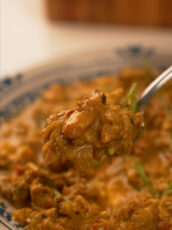
Video 1: Guide to Thai Curry Pastes
Video 2: How to make a PROPER Thai Curry
If you’ve ever wondered what makes Thai curries so aromatic and flavorful, the answer lies in one key element: Thai curry paste. This fragrant blend of herbs, spices, and aromatics forms the backbone of many classic Thai dishes.
In this guide, we’ll explore the five essential Thai curry pastes—red, yellow, green, panang, and massaman—plus the common base ingredients they share. We’ll also talk about why using a mortar and pestle can make all the difference in flavor, and how you can make them at home.
The Aromatic Base for (almost) All Thai Curry Pastes

Almost every Thai curry paste starts with the same fragrant base:
- Lemongrass (white part)
- Galangal
- Shallots
- Garlic
- White peppercorns
- Shrimp paste
This foundation is pounded into a paste, then customized with additional ingredients depending on the curry you’re making.
Mortar and Pestle vs. Food Processor
While you can use a food processor or blender for convenience, a mortar and pestle produces a deeper, more complex flavor. Pounding by hand ruptures plant cells and releases essential oils, creating chemical reactions that boost aroma and taste. A food processor chops rather than crushes, so you won’t get quite the same richness.

If you want your curry to taste like it came from a Thai grandmother’s kitchen, the mortar and pestle is worth the workout (10–20 minutes).
That being said, I won’t judge you if you use a storebought curry paste. Just make sure it’s from a Thai brand! Since making the pastes from scratch is a laborious process, many Thai’s buy their curry pastes pre-made from a local market!
Thai Chilies
Typically these curry pastes are made with dried chilies that have been rehydrated. Only green curry is normally made with fresh chilies. Prik haeng (dried red spur chiles) are the most commonly used type which have a milder, sweet flavor and produce an intense red color. You can substitute with guajillo chilies if you have a hard time finding a Thai variant.
Additionally, dried bird’s eye chilies are used for heat. These are the small, thin, and pointy chilies typically associated with Thai cooking. They pack an intense, fiery punch.
How to Make These Thai Curry Pastes
Yield: 3-4 servings
Aromatic Base
- 2 stalks lemongrass (white part), finely chopped
- 2 tbsp galangal, finely chopped
- 1/4 cup shallot, finely chopped
- 6 cloves garlic, finely chopped
- 2 tsp shrimp paste
- 1/2 tsp white peppercorns
Pound everything together in a mortar and pestle until it becomes a smooth paste (10-15 min) or blend in a food processor.
Red Curry Paste (Prik Gaeng Phed)

Flavor profile: Spicy, aromatic, and versatile.
Add to the base:
- 30 g dried red chillies, soaked
- 2 cilantro roots (or stems)
Red curry paste is the most versatile and is used in dishes like Thai red curry chicken, duck curry, and spicy soups.
Yellow Curry Paste (Prik Gaeng Karee)

Flavor profile: Warm, earthy, and slightly sweet.
Add to the base:
- 30 g dried red chillies, soaked
- 1 tsp fresh turmeric
- 1 tsp curry powder
- ½ tsp coriander seed (toasted)
- ½ tsp cumin seed (toasted)
Perfect for Thai yellow chicken curry, fish curry, and vegetarian curries. The turmeric gives it a vibrant golden color.
Green Curry Paste (Prik Gaeng Keow Wan)

Flavor profile: Fresh, herbal, and intensely fragrant.
Add to the base:
- 30 g fresh green chillies
- ½ tsp cumin seed (toasted)
- ½ tsp coriander seed (toasted)
- 2 cilantro roots
- 2 kaffir lime peels
- 15 sweet Thai basil leaves
Used in green curry chicken, beef, or fish balls, this paste is known for its bright herbal notes.
Panang Curry Paste (Prik Gaeng Panang)

Flavor profile: Mild, nutty, and slightly sweet.
Add to the base:
- 30 g dried red chillies, soaked
- ½ tsp coriander seed (toasted)
- 1 kaffir lime peel
- 2 tbsp roasted peanuts
This thick, rich paste is perfect for beef panang curry, pork panang, and even tofu dishes.
Massaman Curry Paste (Prik Gaeng Massaman)

Flavor profile: Aromatic, with Middle Eastern and Indian spice influences.
Add to the base:
- ½ tsp coriander seed (toasted)
- 1 black cardamom pod
- ¼ tsp cloves
- ½ cinnamon stick
- ¼ tsp cumin seed (toasted)
- 2 cilantro roots
Often used in massaman beef or lamb curry, this paste is milder and more aromatic than others, pairing perfectly with potatoes and peanuts.
How to Use Thai Curry Pastes (Makes about 4 servings)

Once you’ve made your paste:
- In a pot, heat a 3-4 tbsp of coconut milk over medium-low heat until the oil separates. (Be patient! This can take up to 10 minutes).
This step is called “cracking” the coconut milk. It’s a CRUCIAL step that cannot be skipped! When the coconut milk splits into the coconut solids and coconut oil, you have an oily base that is ready to accept all the fat soluble flavors of your curry paste.

- Add about 3-4 tbsp of your curry paste and saute until caramelized and the oil changes to the color of your curry paste, about 2-3 minutes. The curry paste is full of flavorful aromatics that need to be bloomed. As it fries in the separated oil, the Maillard reactions develops a deeper, roasted complexity that you just can’t achieve by adding the paste to a wet, emulsified liquid.

- Add about 1 cup of coconut milk and 1 cup of broth or water and bring it to a simmer.
- Season with palm sugar (about 1-2 tbsp) and fish sauce (about 1-2 tbsp) and add any other ingredients you’d like (proteins, green beans, mushrooms, potatoes, lime leaves, chilies, etc…).

- The finished curry should have a layer of colorful and aromatic oil on top
- Serve with jasmine rice and enjoy!


The Ultimate Guide to Thai Curry Pastes
4
servings20
minutes20
minutesIngredients
- Curry Paste Base
2 stalks lemongrass (white part)
2 tbsp galangal, chopped
1/4 cup shallot, chopped
3 -6 cloves garlic, chopped
2 tsp shrimp paste
1/2 tsp white peppercorns
- Red Curry
30 g dried red chillies, soaked
2 cilantro root
- Yellow Curry
30 g dried red chillies, soaked
1 tsp fresh turmeric
1 tsp curry powder
1/2 tsp coriander seed
1/2 tsp cumin seed
- Green Curry
30 g fresh green chillies, chopped
1/2 tsp cumin seed
1/2 tsp coriander seed
2 cilantro root
2 Kaffir lime peel
15 sweet thai basil leaves
- Panang Curry
30 g dried red chillies, soaked
1/2 tsp coriander seed
1 kaffir lime peel
2 tbsp roasted peanuts
- Massaman
1/2 tsp coriander seed
1 black cardamom pod
1/4 tsp cloves
1/2 cinnamon stick
1/4 tsp cumin seed
2 cilantro root
- To make a curry
300 ml coconut milk
240 ml water or stock
1-2 tbsp palm sugar
1-2 tbsp fish sauce
Proteins and other ingredients
Directions
- Curry Paste
- For each curry paste, mince all the corresponding ingredients and pound in a mortar and pestle with a pinch of salt until it becomes a smooth paste. This will take about 10-15 minutes of constant pounding.
- Alternatively, you could use a food processor or a combination of the two (pound for about 5 minutes, then finish in a food processor).
- To make a curry
- In a pot, heat a 3-4 tbsp of coconut milk over medium-low heat until the oil separates. (Be patient! This can take up to 10 minutes).
This step is called “cracking” the coconut milk. It’s a CRUCIAL step that cannot be skipped! When the coconut milk splits into the coconut solids and coconut oil, you have an oily base that is ready to accept all the fat soluble flavors of your curry paste. - Add about 3-4 tbsp of your curry paste and saute until caramelized and the oil changes to the color of your curry paste, about 2-3 minutes. The curry paste is full of flavorful aromatics that need to be bloomed. As it fries in the separated oil, the Maillard reactions develops a deeper, roasted complexity that you just can’t achieve by adding the paste to a wet, emulsified liquid.
- Add about 1 cup of coconut milk and 1 cup of broth or water and bring it to a simmer.
- Season with palm sugar (about 1-2 tbsp) and fish sauce (about 1-2 tbsp) and add any other ingredients you’d like (proteins, green beans, mushrooms, potatoes, lime leaves, chilies, etc…).
- The finished curry should have a layer of colorful and aromatic oil on top.
Serve with jasmine rice and enjoy!